Power Suit Project
For the occasion of the semiquincentennial of the United States of America, Deb O unleashes her magnum opus: the Power Suit Project! Born of a lifetime of fabricating, it is a resounding statement of anti-authoritarian creativity.
Barbie Coat
*
Barbie Coat *
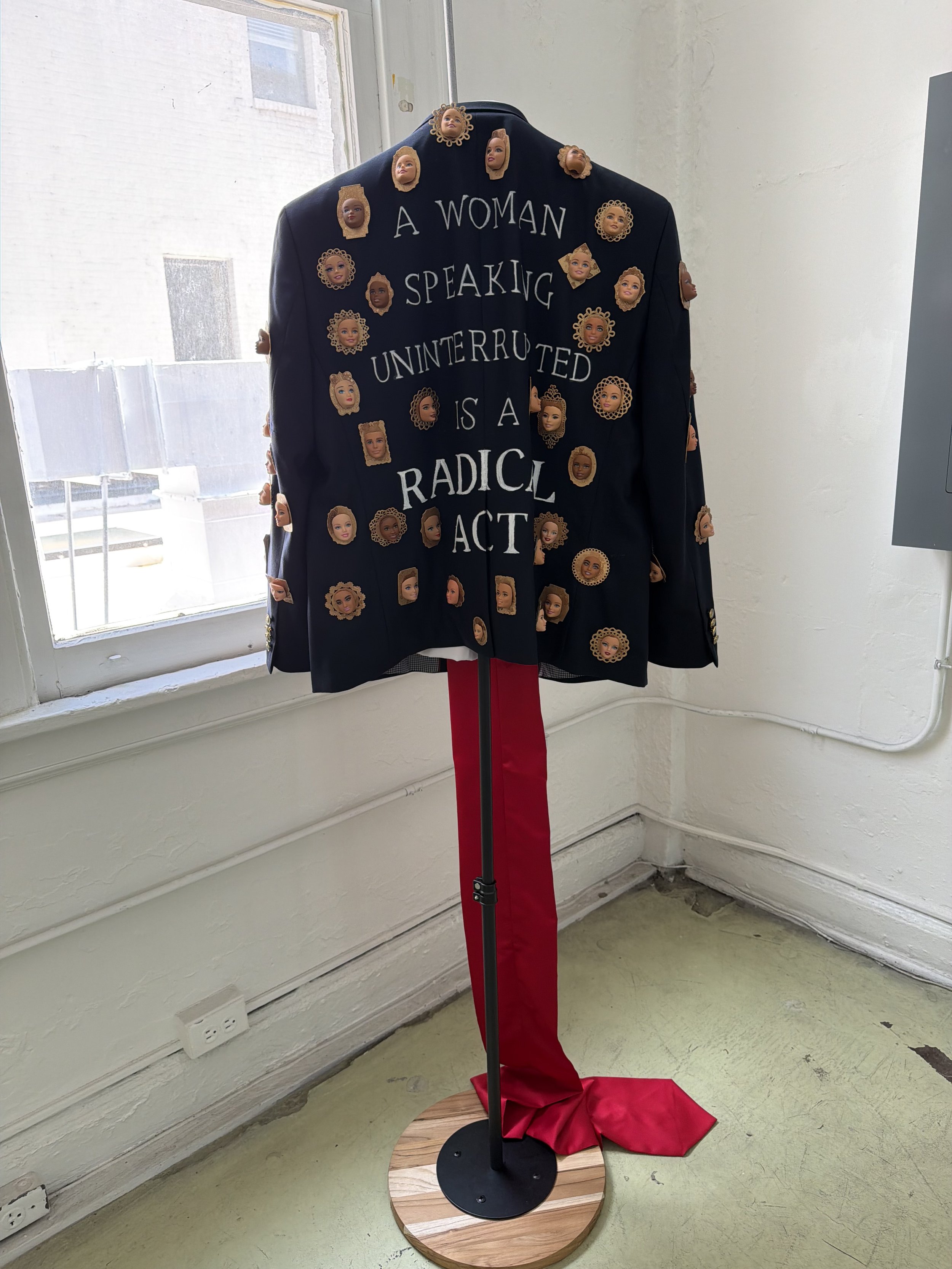
Even after Greta Gerwig’s world-famous 2023 film Barbie, the Mattel toy cannot escape misogynistic implications. It was an apparent attempt to grant autonomy and subjectivity to this mass-produced image of a silent, smiling woman and wrest it from corporate control. The film, which was in fact produced by Mattel, lightly satirizes them; an ineffectual Will Ferrell leads a nebulous band of men in suits who try to curb Barbie’s (Margot Robbie’s) quest for self actualization. Deb O’s Barbie coat plays with these associations; the suit itself is the frame, in both the literal and metaphorical sense. It contains the spectre of corporate men, their product, and the rebellion of women all sewn into the same hem.
-
It is worth investigating how this triangulation began. The Barbie doll was first created in 1959 by Ruth Handler, an entrepreneur and (along with her husband) the co-founder of Mattel. One day as she was observing her daughter playing with paper dolls it struck her that there was a complete lack of adult dolls on the market for young people to play with. Up until that point, paper dolls, meant to represent babies, had been the norm. Daughters would practice their socialized roles early by “taking care of” these babies; essentially, they would imitate their mothers. Handler wanted to pioneer a different model, which she named after her daughter, Barbara. The Barbie she created was based on the Bild Lilli, a popular West German adult doll, based on a slightly racy satirical comic strip, who you could choose outfits for. The early sixties in West Germany were a time when it aggressively differentiated itself from the Eastern Bloc through one mode in particular: consumerism. Bild Lilli was made of polyurethane rather than the classic paper. She was also blonde.
The coat is adorned with the carefully scalpeled faces of one hundred and two Barbies. Significantly, Deb O has included only these faces, leaving out the commodified bodies of the dolls entirely. This reveals as much as it hides. The faces themselves have an eerie impersonality, with mute eyes and frozen smiles. However, they are mounted on decorative plaques (with gold and layers of brown wash, creating an almost religious patina) that ennoble the faces and give them a different kind of life. A sort of existence after death, like that of death masks, which traditionally replicate the visages of historical figures. This staid tradition would not seem to connect to the barbie if not for L'Inconnue de la Seine (the unknown woman of the Seine). In the 1880’s a drowned young woman (who couldn’t have been more than sixteen) was pulled out of the river; her body and face being perfectly intact, suicide was suspected (what was she rebelling against?). Apocryphally, a pathologist at the morgue thought her visage was so striking that he cast her a death mask in plaster. Much like the equally inscrutable Mona Lisa, her face became incredibly popular and lived on in numerous reproductions and copies, both in France and abroad (including in the US). The literary critic Al Alvarez once wrote: "I am told that a whole generation of German girls modeled their looks on her." The next generation’s model was Bild Lili.
If the faces of the Barbies are still an inscrutable symbol within the larger framework of Deb O’ suit coat, the text she has included throws both elements into sharp relief. Painted in large letters across the back are the words: “a woman speaking uninterrupted is a radical act.” This is a famous quotation from Bess Wohl's 2025 play, Liberation, about the upsurge of second wave feminism in the early seventies. The play focuses on a mother daughter pair that couldn’t be further from the Handlers (the founder of Mattel and her daughter); its frame narrative concerns a woman in 2025 looking back on her mother’s involvement in the movement. Going back and forth in time, the play focuses on the nitty gritty dialogues and debates of the women who made up the movement of the seventies in order to illuminate our present disaster (notice the blood red tie on the front of the suit--the color of the republican party).
If Barbie is finally free to speak for herself, then perhaps she can merge with the tradition of Bess Wohl's warriors. Perhaps the mask of L'Inconnue de la Seine can be incorporated as well, no longer just projected on. In her ambiguous and unresolved monument, Deb O attempts to bring these silent faces to the light, to invite them to speak. In the poet Rainer Maria Rilke’s only novel, he writes of the L'Inconnue de la Seine: “The caster I visit every day has two masks hanging next to his door. The face of the young one who drowned, which someone copied in the morgue because it was beautiful, because it was still smiling, because its smile was so deceptive – as though it knew.”
Indigenous People Coat
*
Indigenous People Coat *
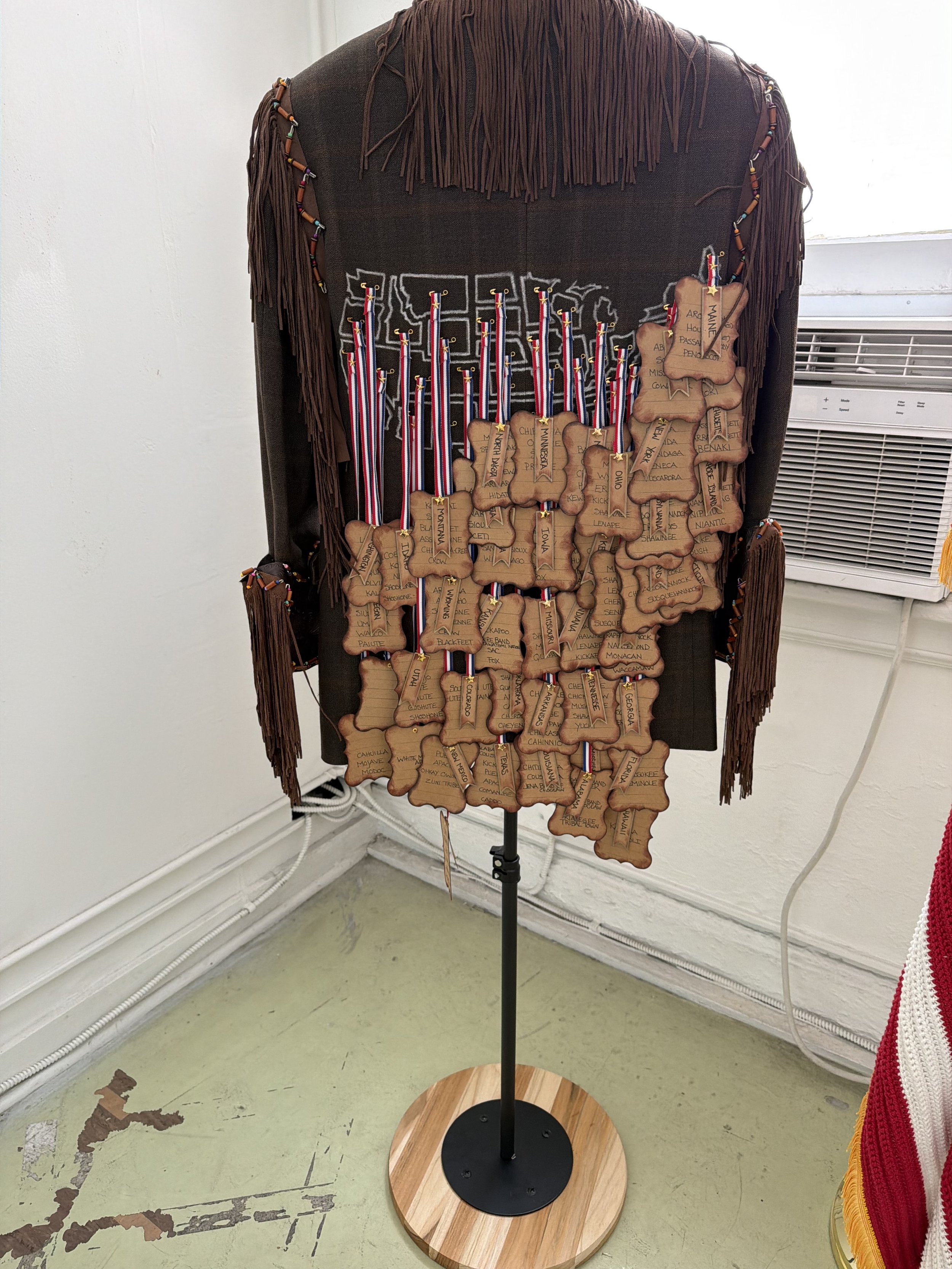
Deb O’s coat honoring the people indigenous to North America has the paradoxical feeling of weight and weightlessness all at once. How has she achieved this effect? She has adorned the collar, lapels, and sleeves of the suit with fringe and beads. The back of the coat presents a carefully stencilled map of the US. Two overlapping tags are pinned to each of the fifty states: a smaller one with its “official name” overlaying a larger one with the name of all the tribes that have lived, do live in this territory. These tags, crowded into the small space of the back of the suit coat, overwhelm and weigh it down. And yet, as one examines the prodigious effusion of Tribe names, Place names, there is a buoyant sense of a phoenix rising out of the ashes, coming to the surface and overtaking the false lines on the map: obliterating them. These arbitrary borders are the history of land grabs, betrayals, and “progress.”
-
It is important to note that Deb O is not Indigenous American. She is the granddaughter of Polish immigrants who moved to Milwaukee. She tells me that growing up, every summer her family would go to the Wisconsin Dells, where she encountered members of the Ho-Chunk tribe. Attending powwows, she was extremely inspired by the manner in which clothes were adorned and crafts were made. Meanwhile, what she never knew about or saw (until she was much older) was an unmarked building down by glimmering lake Michigan, which had once functioned during the school year as an “Indian Boarding School” for the “reeducation” of Native Americans. Part of the mission of the United States Government until well into the 1930s was the “civilizing” of Indigenous Americans through often forced adoption practices and/or compulsory study at the boarding schools, of which there were three in Wisconsin alone. This was glamorized kidnapping. As per the orders of Army Officer Richard Pratt, children were forced to speak English, learn whitewashed versions of history, cut their hair, dress in uniforms, and “integrate.” Sexual, physical, psychological, and religious abuse were rampant.
Deb O’s coat is not a piece that speaks for Indigenous Americans (that has happened enough) but a map of her own epiphanies about the reality of their treatment within the United States, in the past and present, in her home state and in every state. Her piece is about the ways in which language was suppressed and forgotten (the Tribal names are as complete a list as she could compile). It is about the ways in which the United States and its people value surface appearance (connected to materialism and greed) over deeper, spiritual values. This is reflected by the lines drawn on the land. It is reflected in the “Indian” aesthetics that have been stolen, caricatured, and finally “integrated” into the culture so that their implications may be neutralized and kept at a safe distance.
The decorative element but not the deeper meaning of Native American clothing and aesthetics have been (as all things have) subsumed into the Culture Industry, to use Theodor Adorno’s term. Even Deb O, as a young person, was able to enjoy the spectacle of this culture from a distance (the surface of clothing, ritual, color), but was not given the context to understand its meaning. Commenting on this, she has used fake fringe and fake cuffs, not leather. The beads that adorn the collar and the lapel are plastic, held together by safety pins. The point is that the Culture Industry has vulgarized, secularized, and mass produced elements of indigenous dress, severing them from their culture and context. This development is congruent with the development of the power suit. The incorporation or appropriation of these elements into the sports (rather than suit) coat was also key in the manufacturing of the cowboy image. Hollywood and Tin Pan Alley invented the idea of a rugged, white, male cowboy, who in fact, never really existed. Cowboys, or ranchers, were by and large, Native American, Mexican, Black.
But of course, though ethnic peoples have always been central to North America both before and after the official formation of the United States, the invention of white people and the myth of their dominance and centrality has obscured much (Deb O gets the last word by letting the tribal names obscure the map). After all, what is fringe? It is not just decorative. Metaphorically, Deb O adorns her coat with fake fringe in order to question who has been pushed to the fringes, but is in fact central. There was no center to the land before the United States drew them. There were no fringes. Territory and borders existed, but they were operated in an entirely different, less rigid manner, one without a center or fixed perspective. One that couldn’t be further from the colonial, aerial view propagated by maps and drones. It is a local perspective that even the brutal “discipline” of those boarding schools could not entirely shatter. And so if the Tribal names in Deb O’s suit weigh down the official map, one can only wish that they pull it all the way down into the soil. There are so many marked and unmarked graves down there. To ashes we all return, like a child erasing a chalkboard at the end of a lecture and wiping the slate clean. Will any chalk marks remain?
No New Wars Coat
*
No New Wars Coat *
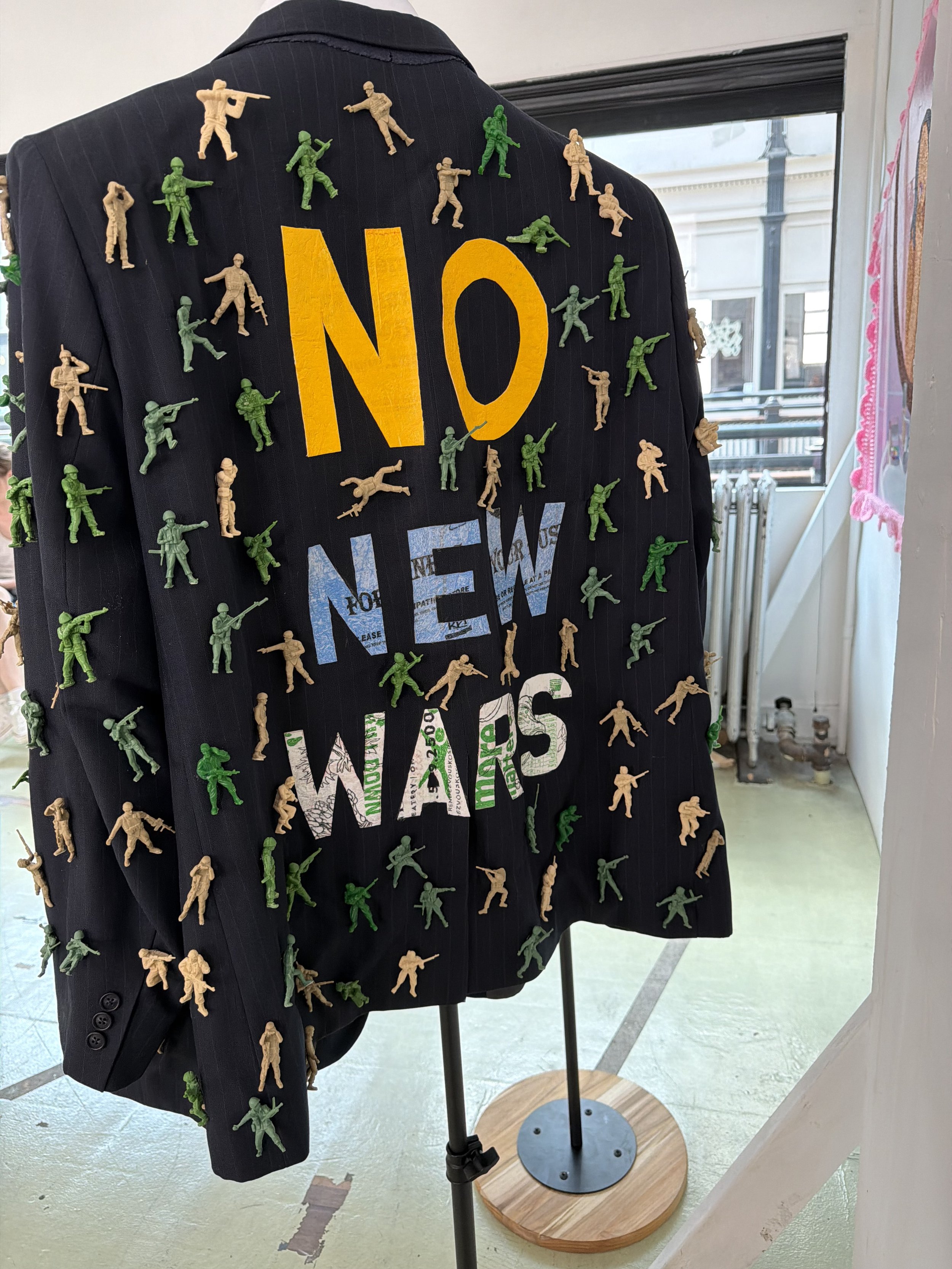
It is no coincidence that during the 1950s, the height of the American Empire, not only barbies but the iconic green army men toys were born. Both were manufactured from flexible, cheap plastic (though the soldiers were cheaper than the dolls, which were composites not just polyethylene). Both codified certain gender roles that quickly stretched to the breaking point. Both were synecdoches for a global empire of plastic and nuclear frisson, of profound abundance coupled with harrowing destruction. These paradoxes had existed prior to World War II, but after that war to end all war, they were magnified to titanic and overbearing proportions. They also paved the way for yet another war. It didn’t take long.
-
Here, Deb O’s message is forceful and simple: “no new wars.” This text, fashioned from plastic grocery bags that she has ironed and cut out to form letters, is emblazoned on the back of the suit. The green army men are pinned to every other square inch. American Imperialism (the flipside of American exceptionalism) is a phenomenon wherein these soldiers, metaphorically if not literally, cover every square inch of the globe. Deb O attempts to trace our current climate of belligerence back to its roots. Like the disposable garbage bags used to fashion the text, the green army men, under enough heat, would just melt away. We must consider how, if this endless chain of wars and waste does not stop, we too will dissolve into the ever hotter sun, the ever rising sea.
We live in the sunset of an empire with no toys, images, stories or symbols to help us envision a different future. We have only the past, piling up in endless waste heaps. Deb O fashions what she can out of the wreckage. In his “Theses on the Philosophy of History,” the philosopher Walter Benjamin, analyzing Paul Klee’s famous painting, writes: “This is how one pictures the angel of history. His face is turned toward the past. Where we perceive a chain of events, he sees one single catastrophe which keeps piling wreckage and hurls it in front of his feet… The storm irresistibly propels him into the future to which his back is turned, while the pile of debris before him grows skyward. This storm is what we call progress.”
We the People
*
We the People *
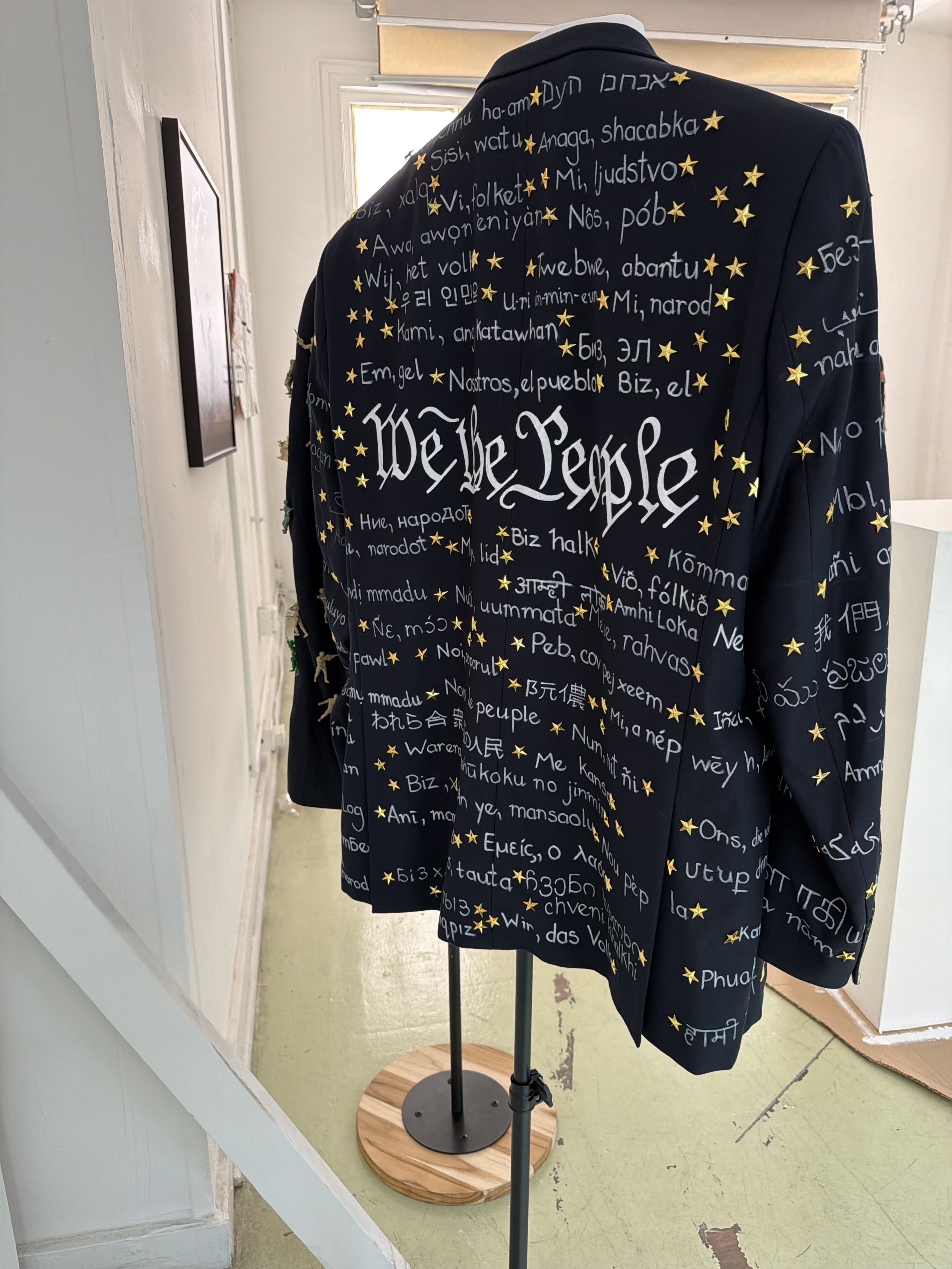
“We the people hold these truths to be self-evident that all men are created equal.” Few statements in human history have become more famous. Or more contested. Not so much in the court of philosophical liberalism but because of their ramifications within the context with which they were drafted. The limitations of the men who drafted them (a precursor to the “men in suits” Deb O’s project deconstructs) and their hypocrisies we observe comfortably from a present day standpoint are all too apparent. Nonetheless, we can reiterate a few. Obviously, these words applied only to white men who owned property and were thus seen as members, not mere subjects of a Democracy. Deb O has been careful to call the overall statement of purpose for this project a humanifesto for a reason. They also entirely ignored the existence of chattel slavery, of which more than one of the founding fathers partook, and which allowed the very existence of the nascent nation, economically speaking. As the novelist Toni Morrison argues in her brilliant study, Playing in the Dark: Whiteness and the Literary Imagination, the philosophical ideal of “all men being created equal” only became possible historically because of the existence of chattel slavery, which reduced men (and women) to goods to be traded, not human beings. “Freedom” cannot exist in a vacuum, it can only be thrown into relief by slavery. In the United States, Equality, as an ideal, is predicated on vast inequality. One makes the other possible.
-
After the abolition of slavery and the further influx of immigrants from all around the world, a slow, torturous, tenuous, and imperfect process began that would lead us to where we are today. Now, it is not taken for granted that “all men” just means white, protestant men with a certain amount of wealth. It actually includes the entire population. This revolution in thinking has been hard won, and is far from resolved. Here, Deb O makes her vital contribution. Armed with an array of paint pens, she has adorned this suit coat with the words, we the people in hundreds of languages. These words cover the suit entirely. Her selection is also important: “We the people” is the most genuinely pluralistic and idealistic part of this declaration. By including it in so many languages and alphabets, she is reaffirming the rights of anyone and everyone who exists within the United States. This is not a battle fought lightly. As we see with the terrorism of ICE, the stakes are high. Deb O even needed to fight the fabric of the suit coat itself just to get the paint pen legible; she retraced the letters of each language over and over and over again until they showed. Until the suit would succumb and stop rejecting the influence which it was so clearly trying to expel. But the suit is hollow and empty, and the meaning Deb O has inscribed on it must triumph over our crumbling empire of hollow men. The chorus of voices she has conjured cannot be muted. Once inscribed, they cannot be erased. Over and over and over and over again we must say and write that they cannot be erased.
Human-ifesto
Power Suit Project: A Manifesto
“I am the decisive element.”
— Goethe
1. For the occasion of the semiquincentennial of the United States of America, Deb O unleashes her magnum opus: the Power Suit Project! Born of a lifetime of fabricating, it is a resounding statement of anti-authoritarian creativity.
2. Deb O takes twelve used suit coats, each bearing the weight and marks of an individual history, and alters them entirely on both the outside and inside. They will hang from a ceiling, with mirrored flooring below so that viewers may look at both aspects of each piece. Every suit coat represents one of the ways in which our moribund patriarchal culture has attempted to subsume and destroy everything in its path— twelve different diagnoses for the symptoms of our collective illness. We have: the stock market, the history of slavery, voting rights and disenfranchisement, misogyny, the military industrial complex, climate change, homophobia and transphobia, the long oppression of Indigenous Americans, education, late capitalism, and finally, as an expression of hope, defiance and vaunted inclusivity, the phrase we the people embroidered in 500 (!) languages. Neon catcalls, lines of ticker tape, maps of indigenous territories, and many other powerful motifs constitute the myriad textures of each piece.
3. Using applied fabrics, embroidery, macrame, hot glue magic, ribbons, collaged paper imagery, broken jewelry, beads, doll parts, bottle caps, dye, safety pins, and much more, Deb O has crafted sculptures carefully built up around the core structure of each suit coat. They retain their shape and symbolism while turning our assumptions inside out through the process of their alterations.
4. Artists, with their three dimensional, ambiguous, personal perception of the world, are our best hope of disrupting things as usual. Critical thinking and education seem to be conspicuously out of fashion. They have been replaced by the noise of media and social media conglomerates, algorithms, AI, and the general hysteria of information. Deb O’s project is an urgent attempt to rescue our attention from the clutches of oblivion by forcing viewers to look at densely constructed three dimensional objects that definitively (de)construct the status quo that has all but suffocated us like a necktie that is too tight.
5. What is the power suit? Born with the rise of Wall Street at the height of the “Greed is Good,” Reaganite eighties (the Rosetta stone of our current crisis), it is characterized by broad shoulders, sharp lines, and pinstripes. These rigid lines match the vertical skyscrapers and lines of code that came to embody the respectively physical and abstract centers of US power. The power suit is the sartorial symbol of corporate ladder climbing, which paradoxically combines ruthless personal ambition in a “dog eat dog” world with the rigid linear lockstep of corporate conformism. We must not forget, suivre, the French word from which “suit” derives means “to follow.”
6. Image reifies reality. Films like American Gigolo, Wall Street, and Miami Vice have as much to do with the rise and meaning of the power suit as anything else. In fact, they are synonymous: the proliferating image of projected power, ambition and confidence. “The clothes make the man.” The power suit is capitalism's uniform, its armor, its patriarchal drag. As seen in Mary Harron’s 2000 film American Psycho, there is a straight line between dressing the part and dressing to kill. The uniform allows for sadistic tendencies to bloom and flourish undetected under an official seal of approval. The closer one gets to power, the closer to corruption and internal rot. The suit is the mask, which has become the man.
7. Thus, personal adornment is the uniform of opposition. This has been the case within the history of the suit itself as it has taken on a great variety of valances, connotations and nuances over the last 150 years. It has seen endless cycles of moderations, alterations, and occasional flames of individual subversion. However, Deb O is taking the suit beyond a mere statement of fashion (or rebellion, or conformity) and into the realm of sculpture, form, critical commentary, art.
8. Robert Frost wrote about the road less travelled. In the Power Suit Project, Deb O makes it clear: now, there are two paths for us to take. Each coat contains its opposite; both paths are present.
9. Power Suit Project blurs the line between outside and inside so completely that a piece of clothing can stand in for the sins of a country and a country can be summed up in a piece of clothing.
10. In 2026, the US will be 250 years old. From the cradle of stolen indigenous lands to the original sin of chattel slavery to the painful strivings towards an imperfect Democracy, Power Suit Project is a big picture look at where we have been and where we might be going. At a time where, more than ever, Americans are being targeted for their appearance alone—as ICE has proven to us—it is worth asking the bitter question: what does it mean to be an American? Is it just about outward appearances?
11. Deb O is in a unique position of authority to weave this tale. Growing up in Wisconsin as the daughter of Polish immigrants, she has always observed American culture from an outsider's perspective. Often visiting the Native American reservation near her home, as a youth she garnered a deep knowledge and understanding of their traditions of making and crafting (which she brings to bear in Power Suit Project). Her affinity for indigenous culture sharply contrasted her attempt to adjust to the mainstream of US society: a profoundly alienating experience. For 18 years Deb O worked at the General Motors factory, building electronic control units in an assembly line. During her stint there, she could barely get out of her car in the morning; she would sit paralyzed in the grey parking lot. Then something internal shifted and she walked away forever, spending several years with theater artists and activists in Poland during the waning days of the Soviet Union. Deb O returned to the US with an unquenchable fire propelling her forward. Above all, she sought education. She received her undergraduate degree in theater design (with a minor in studio art and art history) from Marquette University and her MFA in theater design from Yale. She has since taught everywhere, made theater and film incessantly, and worked in numerous forms including mask making, clowning, folk art, and gymnastics. As an educator she incites critical thinking and self sufficiency (the proudly didactic purpose of Power Suit Project) while supporting those who might otherwise not have a chance. She remains fiercely non-conformist. The Power Suit Project is a monument to Deb O’s self-driven, bullshit free trajectory as an artist and a person.
12. The work poses an essential challenge to the viewer. Do the same as she has done: become yourself.